

Aluminosilicate cenospheres represent an engineered mineral raw material derived as a co-product of coal combustion, prized across manufacturing sectors for low bulk density, spherical geometry, and elevated thermal tolerance. Procuring these hollow micro-particles across European industrial markets requires precise technical alignment between chemical composition, particle size distribution, and batch documentation. When procurement parameters fail to match end-use production criteria, processing variations and material waste inevitably emerge.
Sourcing begins by establishing exact functional demands across composite engineering, construction chemistry, refractories, or oilfield drilling fluids. Buyers must verify silica-to-alumina ratios, crush strength, particle diameter ranges, and certified lot analysis prior to order confirmation. Documented quality criteria ensure each delivered consignment behaves predictably across automated blending lines and continuous forming systems.
This technical guide outlines the physical specifications, primary European industrial applications, quality assessment protocols, and supply chain frameworks governing commercial cenosphere procurement. OMB Group provides bulk B2B distribution of industrial raw materials, including cenospheres, across Poland and the broader European market. The commercial scope centers exclusively on raw material distribution, bulk transport coordination, and consistent lot traceability rather than finished chemical formulation or retail supply.
Key Takeaways
- Define clear technical criteria covering particle size distribution, wall thickness, and bulk density before issuing commercial inquiries for cenospheres.
- Differentiate chemical composition parameters, specifically alumina and silica contents, based on operational temperatures and environmental exposures.
- Evaluate crush strength and hollow sphere integrity under actual blending shear and formulation pressure conditions.
- Structure procurement inquiries with verified specifications, packaging types, target tonnages, and structured delivery schedules.
- Establish institutional partnerships with raw material distributors that maintain verified European supply logistics and comprehensive batch certification.
What Are Aluminosilicate Cenospheres and How Are They Specified?
Aluminosilicate cenospheres are lightweight, inert, hollow spheres composed primarily of silica (SiO2) and alumina (Al2O3), filled with air or nitrogen-rich combustion gases. Generated during high-temperature pulverized coal combustion within thermal power plants, these spherical particles float on the surface of wet ash retention ponds, where they are harvested, washed, separated, dried, and classified. While naturally occurring as a combustion co-product, their physical characteristics make them a high-value functional filler in demanding technical formulations.
Specifying cenospheres requires moving beyond broad commodity classifications. Buyers must evaluate several distinct physical and chemical parameters to verify compatibility with manufacturing equipment, mixing cycles, and target mechanical properties. Relying merely on generic commercial grades creates substantial operational risk in automated production lines.
Chemical Composition and Mineralogical Structure
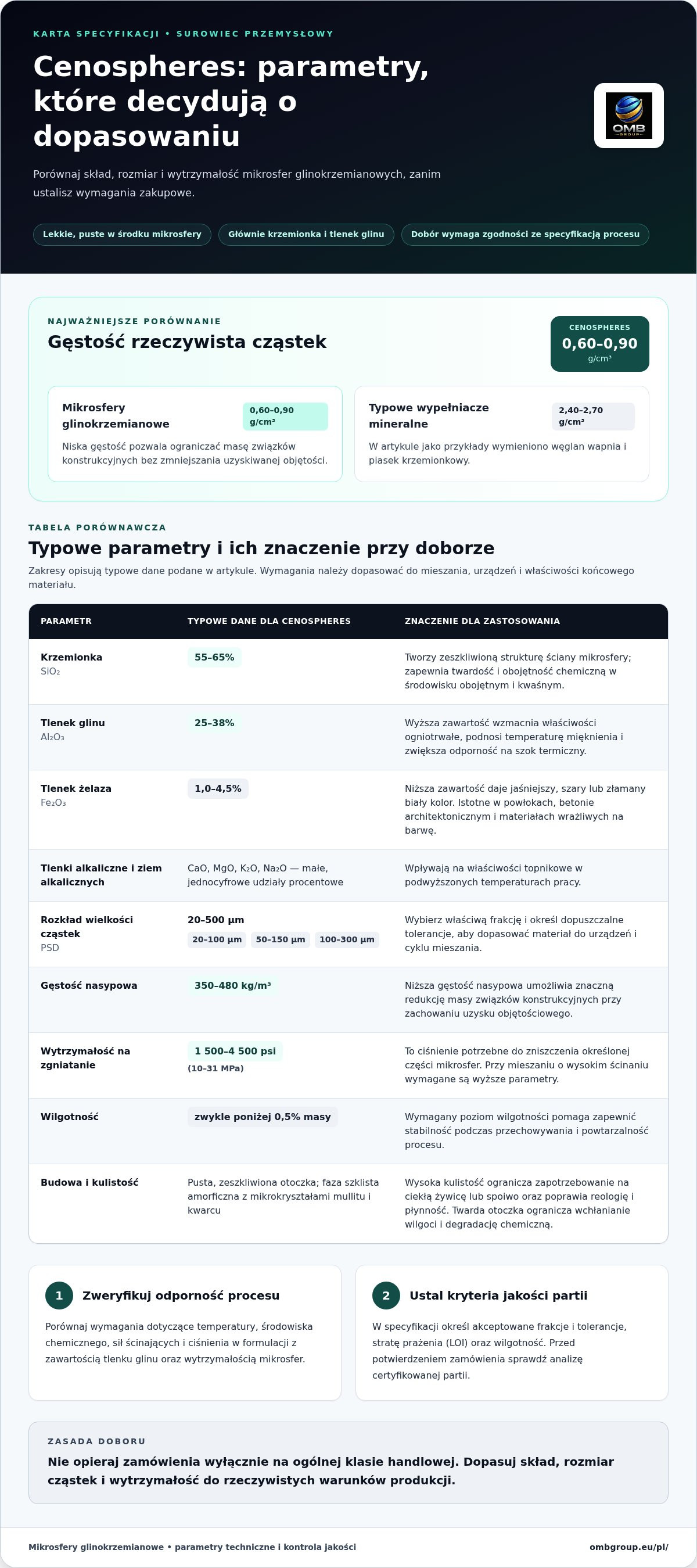
The chemical profile of aluminosilicate cenospheres directly influences their chemical resistance, melting point, and color. The primary oxide constituents are silicon dioxide and aluminum oxide, with iron oxide, calcium oxide, and alkali oxides present in minor proportions:
- Silica (SiO2): Typically ranges between 55% and 65%. Silica forms the vitrified skeletal network of the sphere wall, imparting hardness and chemical neutrality across neutral and acidic media.
- Alumina (Al2O3): Typically ranges between 25% and 38%. Elevated alumina concentrations enhance refractory performance, increasing the softening temperature and augmenting thermal shock resistance.
- Iron Oxide (Fe2O3): Usually limited between 1.0% and 4.5%. Lower iron contents yield lighter grey or off-white cenospheres, which are critical in aesthetic coatings, architectural concrete, and color-sensitive synthetics.
- Alkali and Earth Alkali Oxides (CaO, MgO, K2O, Na2O): Present in low single-digit percentages, influencing fluxing characteristics at elevated service temperatures.
Mineralogically, the shell consists predominantly of an amorphous glass phase alongside microcrystalline mullite and quartz. This hard, vitrified outer crust prevents moisture absorption and chemical degradation under aggressive industrial operating environments.
Physical and Morphological Parameters
The functional performance of cenospheres in downstream formulations depends on their geometric precision and particulate dimensions. Key physical parameters verified in technical data sheets include:
- Particle Size Distribution (PSD): Typically defined between 20 and 500 microns. Industrial grades are classified into targeted fractions such as 20–100 µm, 50–150 µm, or 100–300 µm using air classification or mechanical sieving.
- True Particle Density: Ranging from 0.60 to 0.90 g/cm³, compared to standard mineral fillers (such as calcium carbonate or silica sand) that weigh 2.40 to 2.70 g/cm³.
- Bulk Density: Generally measured between 350 and 480 kg/m³. Lower bulk density permits substantial weight reduction in structural compounds without sacrificing volume yield.
- Crush Strength (Isostatic Collapse Strength): The pressure required to rupture a given percentage of spheres, commonly ranging from 1,500 to 4,500 psi (10 to 31 MPa). Compounding techniques requiring high shear mixing demand higher crush ratings.
- Sphericity and Particle Morphology: The high degree of sphericity lowers surface-area-to-volume ratios, significantly reducing liquid resin or binder demand while improving liquid rheology and flowability.
Rigorous specification prevents formulation failure. A procurement specification must state acceptable tolerances for particle size cuts, loss on ignition (LOI), and moisture content (typically required below 0.5% by weight) to guarantee storage stability and process consistency.
Key Industrial Applications of Cenospheres in Europe
European manufacturing facilities integrate aluminosilicate cenospheres into formulations where structural density reduction, thermal insulation, and flow modification deliver immediate functional gains. Industrial consumption across the European continent spans composite materials, construction chemicals, oil and gas exploration, refractory linings, and technical polymers.
Lightweight Construction Chemicals and Building Materials
In modern construction chemistry, lowering material weight reduces transportation logistics costs, improves worker ergonomics, and enhances thermal insulation properties. Cenospheres serve as primary functional aggregates in dry-mix mortars, lightweight exterior insulation finishing systems (EIFS), joint compounds, and repair mortars.
Unlike standard organic lightweight additives such as expanded polystyrene beads, inorganic cenospheres are non-combustible and carry zero fire propagation risk. In lightweight structural concrete, replacing mineral sand with classified cenospheres yields lower structural loads in precast panels, architectural elements, and offshore concrete structures while maintaining adequate compressive strength. Their spherical shape acts like miniature ball bearings, improving workability, pumpability, and troweling characteristics in cementitious paste.
Polymer Composites, Syntactic Foams, and Automotive Systems
The plastics and composites industry relies heavily on cenospheres to formulate high-performance syntactic foams, structural sheet molding compounds (SMC), and bulk molding compounds (BMC). When dispersed within thermosetting resins (epoxy, polyurethane, or unsaturated polyester), cenospheres reduce part mass, control thermal expansion, and minimize post-cure shrinkage.
In the automotive and transportation sectors, lightweighting directly correlates with energy efficiency and reduced tailpipe or battery consumption. Components such as underbody sound-deadening coatings, bumper stiffeners, and structural interior panels utilize cenosphere-filled polymers. The rigid mineral shell also improves dimensional stability under heat and increases acoustic damping properties compared to unfilled polymer matrices.
Refractory Linings and Foundry Metallurgy
Because of high alumina content and low thermal conductivity, cenospheres find extensive application in thermal insulation systems and metallurgical operations. Refractory manufacturers blend cenospheres into insulating firebricks, castable refractories, and tundish covers for steel mills and non-ferrous foundries.
In metallurgical foundries, including those processing primary non-ferrous metals and industrial alloys, thermal management of molten metals is critical. Exothermic and insulating riser sleeves incorporate cenospheres to slow molten metal solidification in feeder heads, ensuring progressive directional cooling and eliminating shrinkage cavities in structural castings. While foundry managers evaluate alloy charge chemistry such as specialized casting ingots, thermal insulation consumables containing engineered cenospheres protect energy efficiency across holding furnaces and casting ladles.
Oilfield Drilling and Well Cementing Fluids
Deep-well oil and gas drilling operations encounter formations with low fracture gradients where heavy drilling fluids risk fracturing the surrounding geological strata. Specialized low-density cementing slurries formulated with aluminosilicate cenospheres achieve slurry densities as low as 1.10 to 1.40 g/cm³.
These lightweight slurries provide complete hydrostatic containment without exceeding the formation's fracture threshold. The high isostatic crush strength of premium cenospheres ensures that spheres survive severe bottom-hole pressures during pumping and downhole cure cycles, protecting the structural integrity of the well casing.
How to Compare Cenosphere Specifications and Quality Grades
Industrial procurement teams frequently encounter substantial pricing and quality divergence across commercial offerings. Evaluating suppliers requires an objective, side-by-side technical audit separating fundamental physical integrity from simple commercial claims. Without standardized testing metrics, incoming consignments can cause catastrophic batch failures in automated mixing plants.
Core Technical Comparison Matrix
A systematic vendor audit evaluates physical, chemical, and operational variables against production criteria. The following matrix illustrates the standard parameters evaluated by industrial procurement managers:
| Evaluation Metric | Technical Criterion | Industrial Formulation Impact | Standard Verification Source |
|---|---|---|---|
| Particle Size Distribution | D10, D50, D90 sieve analysis | Controls packaging density, packing fraction, surface finish, and resin demand. | Laser diffraction analysis (ISO 13320) / Sieve analysis |
| Crush Strength | Isostatic collapse resistance (psi/MPa) | Determines sphere survival during compounding extrusion, pumping, and spraying. | ASTM D3102 isostatic pressure test |
| Bulk & True Density | Loose bulk density (kg/m³) / True density (g/cm³) | Governs formulation weight reduction, volumetric yield, and dosage cost efficiency. | Gas pycnometry / Tapped density testing |
| Moisture Content | Percentage by weight (<0.5% max) | Prevents clumping, pneumatic conveyance blockage, and polyol-isocyanate side reactions. | Moisture analyzer loss-on-drying (Karl Fischer) |
| Alumina Content | Al2O3 percentage (25% to 38%) | Dictates maximum operating temperature, thermal insulation, and chemical resistance. | X-ray fluorescence (XRF) spectroscopy |
| Float Rate / Purity | Percentage of broken/sinker particles (<5% broken) | Broken spheres act as dense deadweight, increasing slurry viscosity and overall weight. | Sink/float sinker separation test |
Evaluating Isostatic Strength and Handling Integrity
A primary failure mode in manufacturing processes is sphere rupture under mechanical shear. If mixing equipment crushes hollow spheres into sharp shards, three negative outcomes immediately occur:
- The finished product fails to meet target weight and density parameters.
- Uncontrolled fractured particles sharply increase liquid formulation viscosity, choking automated delivery lines.
- Abrasive broken fragments accelerate wear on pumps, extrusion dies, and spray nozzles.
When selecting cenospheres, production engineers must test the raw material using shear regimes representative of plant equipment. Standard planetary mixers or ribbon blenders allow the use of standard-grade cenospheres, whereas high-pressure resin transfer molding (RTM) or twin-screw extrusion compounding necessitates heavy-duty, high-strength grades with certified crush thresholds exceeding 3,000 psi.
Batch Traceability and Contamination Controls
Raw cenosphere harvests contain residual carbon soot, uncombusted magnetic iron fractions, and dense solid ash beads (sinkers). European industrial users require high-purity, processed cenospheres where magnetic extraction, mechanical flotation, and thermal drying cycles have eliminated impurities.
Each shipment must be linked to a certified Certificate of Analysis (CoA) detailing the exact batch number, moisture baseline, bulk density, sieve screening cuts, and loss on ignition. This documentation provides traceability across corporate quality systems, allowing manufacturers to maintain tight product tolerances across variable production campaigns.
Logistics, Packaging, and Supply Chain Planning in Europe
The geopolitical and industrial transitions across Europe have significantly impacted raw material flows. The gradual retirement and operational phasing-down of domestic coal-fired thermal power stations across the European Union have curtailed local harvesting of fly ash co-products. Consequently, European industrial consumers increasingly rely on organized bulk distributors capable of securing stable, long-term non-domestic supply streams while handling cross-border maritime, rail, and road freight.
Packaging Configurations for Bulk Industrial Processing
Given the ultra-low bulk density and fine particulate nature of aluminosilicate cenospheres, proper packaging selection is vital to prevent dust emission, atmospheric moisture uptake, and mechanical transit degradation. Commercial B2B volumes are typically supplied in several standard industrial formats:
- Big Bags (FIBCs): The predominant packaging method across Europe. Sized typically between 400 kg and 600 kg (due to volume constraints of the low-density material), bags feature moisture-resistant internal polyethylene liners, top-filling spouts, and bottom discharge valves for clean integration into automated dispensing silos.
- Paper Valve Sacks: Typically 15 kg to 25 kg multi-wall paper sacks stacked on shrink-wrapped pallets (approx. 400 to 500 kg per pallet). Preferred by specialty chemical formulators operating batch-mix operations requiring manual or semi-automated addition without bulk silo unloading systems.
- Pneumatic Silo Tankers: Direct road-tanker bulk deliveries for large-scale consumers with high-capacity stationary storage silos. Requires dedicated dust filtration systems and precise pneumatic transfer pressure to prevent sphere destruction during offloading.
Managing Delivery Rhythm and Buffer Inventories
Industrial manufacturing lines operating continuous shifts cannot tolerate stockouts of primary filler raw materials. Because international supply lines involve intermodal container freight, customs clearance, and terminal transshipment, maintaining local buffer stock within Europe is standard risk-mitigation practice.
Procurement teams should avoid spot-purchasing when feeding continuous production schedules. A rolling forecast model aligning quarterly production plans with distributor delivery schedules ensures that dedicated inventory remains staged at regional logistics hubs. This operational buffer cushions production facilities against maritime freight delays, weather interruptions, and seasonal supply fluctuations.
Procuring Cenospheres from a Wholesale Industrial Partner
Wholesale distribution of industrial minerals demands institutional scale, reliable quality control, and dependable commercial governance. An experienced sourcing partner acts as a critical link between primary processing operations and advanced European manufacturing operations.
The Role of the Distribution Partner
A specialized raw material distributor manages the complex international supply mechanics that individual manufacturing plants are rarely configured to absorb:
- Quality Assurance: Verification that incoming batches match agreed technical specifications, verified by standard batch-testing protocols prior to European dispatch.
- Logistics and Warehousing: Staging bulk tonnage across strategically positioned distribution facilities, handling customs formalities, and coordinating just-in-time full-truckload (FTL) deliveries.
- Regulatory Compliance: Assuring materials comply with EU REACH registration obligations and corresponding safety data sheet (SDS) statutory standards.
- Supply Continuity: Balancing multi-source supply agreements to guarantee uninterrupted supply even when individual production facilities undergo seasonal maintenance.
OMB Group acts as a dedicated B2B wholesale distributor of critical industrial commodities, delivering certified metals and mineral raw materials across Poland and broader European industrial territories. The company does not formulate finished consumer products or provide engineering services, choosing instead to focus its capabilities on bulk raw material sourcing, contract continuity, and dependable supply chain execution.
Structuring a Commercial Procurement Inquiry
To secure accurate commercial quotations and verify technical suitability, industrial purchasing teams should approach suppliers with comprehensive operational data rather than generic requests. A structured procurement inquiry should outline:
- Specific Grade Requirements: Detailed particle size fraction (e.g., 50–150 µm), target true density, and minimum alumina content.
- Intended Process Environment: Maximum mixing shear, compounding temperatures, and chemical exposure conditions.
- Volume Requirements: Projected annualized tonnage split into expected monthly or quarterly shipment call-offs.
- Packaging and Handling Requirements: Preferred format (e.g., big bags with PE liner and discharge spout) and any site-specific offloading constraints.
- Documentation Demands: Required batch certification, REACH compliance documentation, and designated testing methodology.
Providing this structured information enables the supplier to propose the exact technical grade, schedule appropriate inventory reserves, and provide clear commercial pricing structures.
Secure Your Raw Material Supply
Efficient utilization of aluminosilicate cenospheres requires a disciplined balance between technical specification, physical verification, and proactive supply chain planning. By establishing rigorous criteria for particle size, crush resistance, and density, formulators protect product quality and automate production lines without unexpected process disruptions.
As European industrial production continues to prioritize lightweighting, acoustic attenuation, and thermal efficiency, securing a reliable flow of high-grade raw materials becomes a fundamental strategic advantage. Institutional buyers minimize supply risks by partnering with established wholesale distributors who operate on contract certainty, consistent documentation, and disciplined logistics.
OMB Group provides wholesale distribution of industrial raw materials, including cenospheres, to commercial clients throughout the European market. Supply agreements are structured around verified technical criteria and scheduled bulk deliveries tailored to modern industrial requirements.
Present your technical specifications, required volumes, and target logistics schedules. Submit your industrial cenosphere supply requirements to OMB Group to initiate technical discussions and establish a stable, long-term procurement partnership.
Verified specifications and structured procurement form the bedrock of dependable manufacturing operations.
Frequently Asked Questions
What are the primary differences between white and grey cenospheres?
The visual distinction between white and grey cenospheres stems directly from iron oxide (Fe2O3) concentration. White or off-white cenospheres feature low iron contents (typically below 1.5% to 2.0%) and elevated alumina levels, making them preferred for architectural coatings, light-colored sealants, and aesthetic composites. Grey cenospheres contain higher iron percentages and are widely used in industrial mortars, refractory bricks, oilfield cements, and automotive underbody compounds where color is secondary to structural performance.
How does crush strength affect cenosphere selection?
Crush strength determines the proportion of hollow spheres that survive processing pressures during blending, compounding, and application. If cenospheres break under mechanical shear, their low-density advantage is lost, liquid formulation viscosity increases drastically, and broken glass shards accelerate processing equipment wear. Buyers must assess processing equipment pressures—such as high-shear dispersal or high-pressure pumping—and specify cenospheres with an isostatic crush strength that comfortably exceeds peak manufacturing stresses.
What makes cenospheres superior to traditional mineral fillers like calcium carbonate?
Unlike irregular, solid mineral fillers such as ground calcium carbonate, barite, or talc, cenospheres are hollow spheres with true densities under 1.0 g/cm³. This spherical morphology minimizes resin and binder consumption due to low surface-area-to-volume ratios while providing a "ball-bearing" effect that improves mixture rheology. Furthermore, cenospheres substantially reduce part weight, improve thermal and acoustic insulation, and enhance dimensional stability under thermal cycling.
Are aluminosilicate cenospheres non-combustible according to European standards?
Yes, aluminosilicate cenospheres are fully inorganic, vitrified mineral co-products comprised primarily of silica and alumina. Because they are formed in high-temperature combustion zones exceeding 1,200°C, they are naturally non-combustible and emit no toxic fumes or smoke when exposed to fire. This inorganic composition allows them to meet strict European fire-safety criteria across construction mortars, lightweight drywall panels, and fire-resistant marine insulation formulations.
How are cenospheres packed and handled for bulk industrial delivery?
Cenospheres are predominantly delivered in bulk FIBC big bags (ranging from 400 kg to 600 kg) fitted with protective moisture-proof polyethylene liners, lifting loops, top filling duffles, and bottom discharge spouts. For smaller batch plants, 15 kg to 25 kg multi-wall paper valve sacks are supplied on stretch-wrapped wooden pallets. Material handling requires standard dry-storage environments and pneumatic or mechanical discharge equipment calibrated to move low-density, free-flowing powders without generating excessive abrasive dust.
Does OMB Group supply finished composite formulations or retail packaging?
No, OMB Group operates strictly as a wholesale B2B distributor of industrial raw materials, non-ferrous metals, and mineral commodities. The organization provides bulk-scale delivery of certified cenospheres, non-ferrous casting alloys, and secondary raw materials directly to industrial processors, compounders, and manufacturers across Europe. Commercial operations focus exclusively on procurement logistics, batch compliance, and supply chain continuity, leaving downstream material formulating and finished product processing to manufacturing clients.